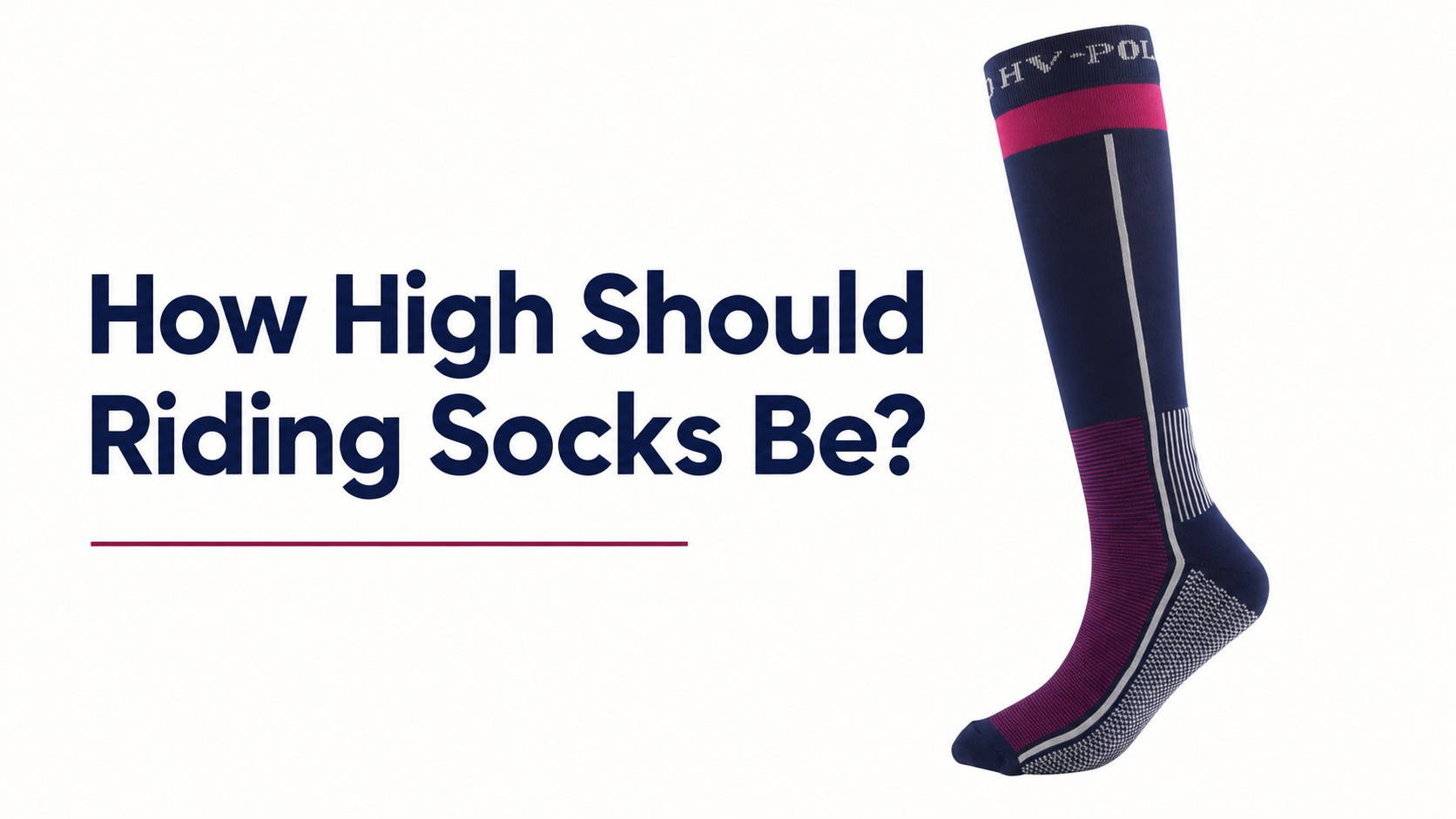
Your sock should cover the skin beneath your boot or half chap without bunching behind your knee. Knee-high horse riding socks suit tall English boots and half chaps. With short paddock boots alone, a crew sock can work. Use your gear, not a generic length label, to choose.
Match sock height to your riding boots
| Footwear | Useful sock height | What to check |
| Tall field or dress boots | Knee-high or over-the-calf | The sock covers the shaft contact area and ends comfortably below the knee crease. |
| Paddock boots with half chaps | Knee-high | Fabric continues under the chap, with no exposed strip of calf. |
| Paddock boots without half chaps | Crew or higher | The cuff stays above the boot edge when you bend and walk. |
| Western boots | Mid-calf or taller | The sock clears the inner boot shaft rather than ending inside it. |
These are starting points, not fixed measurements. Boot shafts, half chaps, calf lengths, and riding positions vary. A sock called “knee-high” may land differently on two riders.
For tall boots, the most useful test is coverage: no bare skin should meet the inside of the boot. For half chaps, cover the full area under the chap. With short boots, make sure the boot edge does not catch the cuff as your ankle moves.
Measure the height you actually need
Start with the riding breeches, boots, and half chaps you normally wear. This matters because the layers change where the gear sits on your calf. Use a soft tape and ask someone to help if you cannot keep it straight.
- Sit with your feet flat and knees bent, then locate the crease behind each knee.
- Note where the top of your boot or half chap reaches on each leg.
- Measure from the floor or heel to that top edge, then to the knee crease. Record the measurement method.
- Pull on a candidate sock and check that it covers the gear contact area without pressing into the knee crease.
- Stand, walk, squat slightly, and sit again. Recheck the cuff and any wrinkles around the ankle.
Measure both legs if your boot shafts sit at different heights. When ordering by a supplier’s size chart, confirm whether “sock height” means heel-to-cuff length on a flat sock or the position of the cuff when worn. Those are different measurements.
Ariat and Dover Saddlery both advise measuring half chaps while wearing the riding layers you plan to use. That same setup gives you a more useful sock-height test than measuring a bare leg.
Do the on-boot fit check
The right height stays right after you move. Pull your socks up smoothly, put on your boots or half chaps, and run through this short check before a full ride.
- At the top: The cuff stays flat. It does not roll, pinch, or fold behind the knee.
- At the calf: The sock stays between your leg and the boot or chap without sliding down.
- At the ankle: No loose fabric gathers where the boot bends.
- At the foot: Your toes have room and the boot still closes as intended.
If the cuff disappears inside a tall boot, try a longer leg length. If it bunches at your knee, try a shorter option or a different size. If the shaft suddenly feels tight, check sock thickness as well as height.
Balance height with thickness and construction
Height only solves one part of the problem. Tall riding boots often fit closely, so a bulky sock can change the fit even when its cuff lands perfectly. Test the pair in the exact boots you plan to wear.
| Design choice | Good question to ask |
| Leg thickness | Will the boot or half chap zip comfortably over the sock and breeches? |
| Foot cushioning | Is there enough room in the toe box when the cushioned foot is inside the boot? |
| Cuff and stretch | Does the top stay up after walking without digging into the calf? |
| Toe seam | Can you feel a ridge after standing or riding for a while? |
| Fabric blend | Does it feel comfortable for your riding season and dry between uses? |
A thin leg with cushioning only where you need it can be easier to fit inside a close boot than an evenly thick sock. For a roomier paddock boot, you may prefer more padding. Either way, judge the combination on your foot.
Specify knee-high riding socks for a group
If you buy for a riding club, tack shop, or private-label range, “knee-high” alone is too vague for a production brief. Give the maker a fit target and the gear your riders use.
- List the intended setup: tall boots, paddock boots with half chaps, or both.
- Provide foot size ranges and a practical calf-height range for each size group.
- Define the cuff landing point relative to the knee crease and boot or chap top.
- Describe leg thickness, desired foot cushioning, cuff feel, and toe-seam preference.
- Test a sample with the actual breeches and boots before approving bulk production.
Our equestrian sock collection includes knee-high riding designs. One listed model, HS410552, specifies a cotton, nylon, and spandex blend, customizable color, and a minimum order of 500 pairs per design, color, and size. Treat those as that product’s published specifications, not universal terms for every style.
For a team range, consider separate adult and youth fit checks. Foot size does not predict calf length, and a single leg length can land too low on one rider and too high on another. Document the approved sample’s dimensions so later reorders match it.
FAQs about horse riding sock height
Should riding socks go above the top of tall boots?
The sock needs to cover the leg where the boot rubs. Its cuff may sit just above the boot edge if that feels comfortable, but it should not fold into the knee crease. Check it while seated and moving.
Can I wear crew socks with half chaps?
You can, but check for exposed calf between the sock cuff and the chap. A knee-high sock is often simpler because it covers the full lower leg beneath the chap.
Are knee-high and over-the-calf the same height?
Brands use these labels differently. Compare the actual heel-to-cuff measurement, then try the sock on. Your calf length and the sock’s stretch determine where the cuff finally sits.
Why do my riding socks slide down?
The leg may be too loose, the foot size may be wrong, or the cuff may lose its hold. Try a better-fitting size and check the fabric after washing. Avoid fixing the problem with a cuff that pinches.
Build a better-fitting riding sock range
We make custom socks for wholesale buyers, including equestrian styles. Explore our horse riding socks, then contact us with your boot setup, size range, and design brief to discuss a quote.