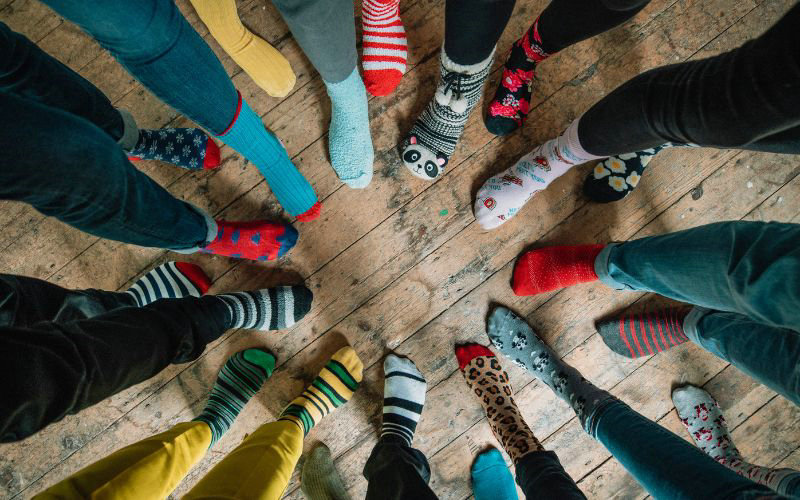
If you want to buy better socks, certification helps you separate real progress from marketing noise. For brands, retailers, and private label buyers, GRS-certified socks can be a smart starting point—but only if you understand what the label does, and does not, cover.
What GRS Certified Socks Actually Mean
A GRS certified sock meets the Global Recycled Standard, a certification used to verify recycled materials and track them through the supply chain. It helps prove that a sock contains genuine recycled input, not just a marketing claim.
For buyers, that means more confidence when sourcing socks made with recycled yarn or recycled polyester. Instead of relying on vague eco language, you have a clearer basis for a recycled claim.
GRS is not only about fiber content. It also looks at chain of custody and broader environmental and social criteria in processing. That makes it more credible than a simple supplier statement.
Still, no certification covers everything. GRS does not automatically mean a sock is perfect in every area, but it is a strong way to support a more reliable recycled claim.
Why this matters for sock buyers
If you manage sock programs for retail, sports, promotions, or apparel, you need documentation that can travel through the entire supply chain. GRS helps by supporting chain of custody and third-party audit requirements, which is useful when your team needs more than a sales pitch.
It is especially relevant when you are buying custom sock collections and want the recycled content claim to remain credible from yarn sourcing to finished socks.
GRS vs OEKO-TEX Standard 100 vs GOTS
These standards are often mentioned together, but they are not interchangeable. If you mix them up, you can end up making weak claims—or worse, drifting into greenwashing.
GRS focuses on recycled content and traceability
GRS is best for products made with recycled input, such as recycled polyester socks. It supports verification of recycled materials, chain of custody, and third-party certification processes.
If your sock line uses recycled yarn, GRS is usually the first standard buyers ask about.
OEKO-TEX Standard 100 focuses on product safety
OEKO-TEX® STANDARD 100 is different. It is a label for textiles tested for harmful substances, from yarn to final product. OEKO-TEX says every labeled item has been tested against strict safety criteria.
That means oeko-tex standard 100 is about product safety, not proof of recycled origin. A sock can be oeko-tex certified and still contain no recycled fiber at all.
GOTS focuses on organic textile inputs
If you are sourcing organic cotton socks, then GOTS matters more. The Global Organic Textile Standard is widely recognized for organic textiles, and GOTS materials explain that organic raw materials can include cotton, wool, silk, and flax.
So if your line uses certified organic cotton, ask for GOTS or gots-certified documentation rather than assuming GRS is enough.
A quick comparison
| Standard | Best for | What it helps verify |
| GRS / global recycled standard | Recycled-input sock programs | Recycled content, chain of custody, third-party audit |
| OEKO-TEX STANDARD 100 | Safer finished socks | Tested for harmful substances from yarn to finished product |
| GOTS / global organic textile standard | Organic cotton textile products | Organic raw materials and recognized organic textile criteria |
| Responsible Wool Standard | Wool-based sock lines | Wool animal welfare and land management standards |
For many buyers, the best answer is not one label. It is the right combination of standards for the yarn, the product, and the market you sell into.
How to Source Eco-Friendly Sock Programs Without Greenwashing
If you want a genuinely sustainable or eco-friendly sock line, start by defining the material story first. Then check which standard fits that story.
For example:
- Recycled synthetic sock line → look at GRS
- Organic cotton line → look at GOTS
- Safety-focused baby or skin-contact line → check oeko-tex
- Wool-rich outdoor line → check responsible wool standard
This matters because different fibers need different proof. A recycled polyester crew style is not documented the same way as merino hiking socks or bamboo socks.
Materials and blends affect your certification path
Most commercial socks are fiber blends. You may see polyester, cotton, elastane, viscose, lyocell, bamboo-derived fibers, or merino in one product. That affects how you source yarn and how you explain the final claim.
A good supplier should be able to tell you:
- what certified materials are used
- whether the recycled content is in the main body or only part of the sock
- whether the heel and toe construction changes the blend
- whether the same claim applies across crew socks, dress socks, and sport styles
If you are building a private label line, it is smart to define your approved fiber list early. That keeps claims consistent across product development and packaging.
A credible eco-friendly sock claim sounds specific
Instead of saying “this is an eco sock,” say what is actually true.
Better examples include:
- made with recycled yarn under a verified standard
- standard 100 certified for product safety
- made with certified organic cotton
- designed for longer lifespan and repeat wear
That kind of wording sounds more professional and reduces confusion for buyers.
What to Ask Your Supplier Before Ordering
Before you place an order, ask for proof—not just keywords. This is where strong sourcing gets practical.
1. Ask which certification applies to the sock
A supplier should explain whether the product is grs-certified, OEKO-TEX, GOTS, or something else. If they only say “eco” or “green,” push for specifics.
Ask which part is certified:
- the yarn
- the finished socks
- the production facility
- or the full chain of custody
2. Ask for transaction and audit documents
For recycled sock programs, a transaction certificate can help support the recycled claim on a shipment level. Third-party audit records also matter, because they show the claim is tied to a real verification process.
You can also ask about factory audits, quality management systems, or buyer compliance processes like ISO or Sedex if those matter to your market.
3. Ask about product quality, not just compliance
A sock still has to perform. That means asking about yarn quality, grip, recovery, wash durability, and construction quality.
If you are developing sport or uniform products, ask how the supplier handles:
- jacquard logo clarity
- compression zones
- reinforced heel and toe areas
- merino performance or moisture management
- finished sock consistency across bulk runs
A sustainable product that wears out too fast is not a strong result.
4. Ask about lead times and scale
Good compliance is not useful if the order flow breaks down. Ask about lead times, MOQ, sample development, and color availability.
SinoKnit has produced socks since 2004, operates more than 300 knitting machines, offers over 100 varieties, supports OEM and ODM, and can source a wide range of materials through its textile supplier network.
That kind of scale matters when you are planning repeat sock programs, promotional launches, or multi-style collections.
5. Ask how the supplier supports your product category
Not every sock manufacturer is equally strong across every segment. Some are better at sports socks, some at gifting, and some at technical grips.
SinoKnit is a wholesale custom sock supplier with categories including custom socks, trampoline socks, cycling socks, fitness socks, and more. You can browse our product page or read our sock certification guide to refine your sourcing checklist.
What a Strong Certified Sock Program Looks Like
A strong program is not just “certified.” It is organized.
Usually, it includes:
- a clear fiber strategy
- matched certification for the claim
- supplier documentation
- stable manufacturing processes
- realistic marketing language
- consistent product quality
That is how you move from a nice-looking label to a more genuinely sustainable business decision.
Whether you are buying an eco-friendly sock, a recycled performance line, or a private label retail collection, the goal is the same: choose a source that can back up the story with real documents and dependable execution.
FAQs about grs-certified socks
What does GRS mean in socks?
GRS stands for Global Recycled Standard. It is a third-party standard used to verify recycled materials and chain of custody in textile products.
Are GRS certified socks the same as OEKO-TEX socks?
No. GRS focuses on recycled input and traceability, while oeko-tex® standard 100 focuses on whether a textile product is tested for harmful substances.
Can cotton socks be GRS certified?
Yes, if the sock contains qualifying recycled materials and the certification scope supports it. But if the main claim is organic cotton, GOTS is usually more relevant than GRS.
What should you ask a supplier for?
Ask for the certification scope, audit information, transaction certificate where relevant, and details on the materials used in the finished socks. Also ask how the supplier handles sourcing, quality management, and lead times.
Are certified socks automatically sustainable?
No. Certification helps, but it does not solve everything. You still need to check the claim, the material blend, durability, production quality, and the broader environmental impact of the product.
Partner with SinoKnit for Excellence in Manufacturing
SinoKnit is a custom sock manufacturer based in China focused on wholesale and OEM/ODM production. It highlights advanced knitting capacity, multiple sock categories, premium materials, sampling support, and after-sales service.
If you are looking for a reliable trampoline socks supplier, contact us today via our Contact Page to send an inquiry and get customized solutions for your business.