
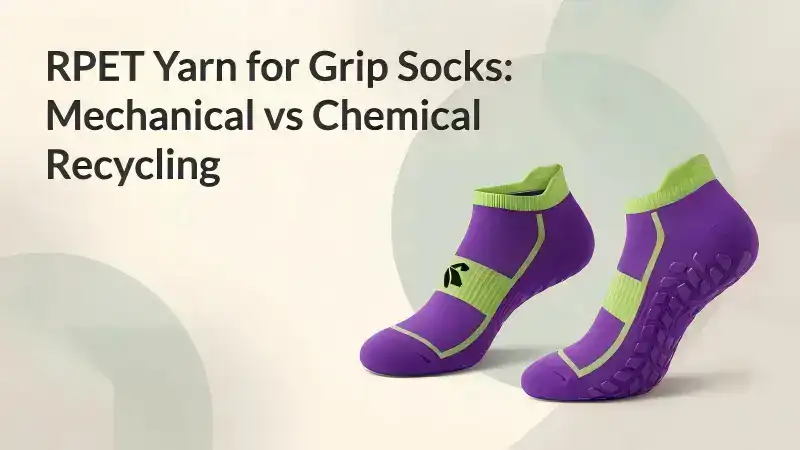
If you’re sourcing RPET yarn for grip socks, understanding the difference between mechanical recycling and chemical recycling can help you choose the right balance of performance, cost, and sustainability. Here’s what you need to know before selecting recycled polyester yarn for your next textile project.
What Is RPET Yarn and Why Is It Popular for Grip Socks?
RPET (recycled polyethylene terephthalate) is a type of recycled polyester made by recycling PET resources such as plastic bottles, post-consumer packaging, and increasingly, textile waste. Instead of relying entirely on virgin polyester, manufacturers recycle valuable materials back into the textile supply chain.
For grip socks, polyester yarn remains one of the most practical choices because it combines strength, comfort, and cost efficiency. When the yarn is made from recycled materials, brands can reduce the demand for new petroleum-based raw materials while supporting better sustainability goals.
Compared with conventional polyester, RPET yarn offers several advantages:
- Lower dependence on virgin materials
- Reduced environmental impact
- Supports recycling and reuse
- Helps divert waste from landfill
- Compatible with modern knit production
However, not all recycled yarn is produced the same way. The recycling process has a direct effect on the quality, durability, and consistency of the final product.
Today, the global textile industry mainly uses two recycling methods:
| Method | Main Feedstock | Typical Application |
| Mechanical recycling | PET bottles, clean textile waste | General textile production |
| Chemical recycling | Mixed PET waste, difficult waste streams | Premium textile products |
Understanding these two approaches is essential when selecting RPET yarn for performance products like grip socks.
For companies looking for different recycled knitting materials, SinoKnit’s Product Center offers a wide range of sock yarn solutions suitable for various applications.
Mechanical vs Chemical Recycling: How the Two Processes Work
Although both methods aim to recycle polyester, they use very different technologies.
Mechanical Recycling
Mechanical recycling is currently the most common method used for the production of recycled polyester.
The process generally includes:
- Collecting recycled plastic bottles or clean PET waste
- Washing and removing labels
- Crushing into flakes
- Melting and extruding into chips
- Spinning new fiber and yarn
This process keeps the original polymer structure largely intact. Because of that, each recycling cycle may slightly reduce the mechanical properties of the material.
Mechanical recycling works best when the input consists of clean PET bottle waste with minimal contamination.
Advantages
- Lower production cost
- Mature manufacturing technology
- Lower energy consumption
- Widely available raw material
- Suitable for large-scale textile production
Limitations
- Sensitive to contamination
- Difficult to process mixed textile waste
- Fiber quality may gradually decline after repeated recycling
- Limited color flexibility because existing dye residues may remain
For many everyday socks, mechanically recycled yarn delivers reliable performance while keeping costs competitive.
Chemical Recycling
Unlike mechanical recycling, chemical recycling breaks PET down into its original chemical building blocks before creating new polyester.
Instead of simply melting plastic, chemical recycling processes separate the material into basic chemical compounds, remove impurities, and rebuild new polyester with properties very close to virgin polyester.
This approach can process:
- Mixed PET waste
- Colored polyester
- Certain used textiles
- Some forms of post-consumer textile waste
- Complex waste polyester
Because contaminants are removed during the process, manufacturers can produce high-quality recycled fibers with more consistent performance.
Benefits include:
- Better fiber consistency
- Improved color control
- Greater purity
- Higher potential for closed-loop fiber recycling
- Better utilization of difficult waste stream materials
The main drawback is cost. Chemical recycling equipment requires higher investment and more complex processing, making chemically recycled yarn generally more expensive than mechanically recycled alternatives.
As textile recycling technologies continue to improve, many experts expect chemical recycling to play a larger role in the future textile circular economy.
Which Recycling Method Produces Better RPET Yarn for Grip Socks?
The answer depends on your product positioning rather than a simple “better or worse.”
Grip socks require a combination of:
- Slip resistance
- Elastic recovery
- Moisture management
- Long-term durability
- Stable knitting performance
Since the anti-slip silicone is applied after knitting, the yarn itself mainly influences the comfort and lifespan of the socks.
Mechanical RPET Yarn
Mechanically recycled yarn is often the preferred option for:
- Promotional socks
- Retail collections
- Sports socks
- Everyday apparel
It offers an excellent balance between sustainability and cost.
When high-quality bottle recycling systems and strict quality control are used, mechanically recycled polyester can achieve consistent performance compared to virgin polyester for many standard applications.
For most buyers, this remains the most economical solution.
Chemical RPET Yarn
Chemical recycling becomes attractive when brands require premium performance.
Typical applications include:
- High-end sportswear
- Compression socks
- Medical textile products
- Luxury apparel
- Products with very high percentage of recycled content
Because contaminants are removed during processing, the resulting polyester fiber typically shows more stable physical characteristics.
This is particularly beneficial when brands pursue certifications such as the Global Recycled Standard or need consistent recycled content across multiple production batches.
Quick Comparison
| Factor | Mechanical Recycling | Chemical Recycling |
| Cost | Lower | Higher |
| Fiber consistency | Good | Excellent |
| Processing complexity | Low | High |
| Suitable raw material | Clean PET bottles | Mixed PET and textile waste |
| Environmental sustainability | High | Potentially higher with advanced recycling systems |
| Large-scale availability | Excellent | Growing |
Rather than viewing mechanical and chemical recycling as competing technologies, many industry professionals see them as complementary solutions. Each serves different market needs and contributes to reducing waste across the textile supply chain.
For buyers, the right choice depends on product requirements, target pricing, certification goals, and long-term environmental sustainability objectives.
Sustainability Beyond Recycling: What Buyers Should Consider
When choosing RPET yarn for grip socks, recycling method is only part of the story. Real sustainability depends on the entire textile supply chain, from raw material sourcing to final sock production.
Beyond just “recycle”
Many buyers focus only on whether the yarn is made from recycled materials, but true impact depends on:
- Energy used in the production of recycled fibers
- Water consumption during textile production
- Efficiency of recycling system in sourcing recycled plastics
- Emissions from transport in the supply chain
A material can be recycled yet still have a high environmental impact if the upstream process is inefficient.
Raw material quality matters
The quality of RPET yarn depends heavily on input materials such as:
- Clean plastic bottles
- Properly sorted PET textile waste
- Post-consumer packaging streams
- Mixed cotton and polyester blends (more complex to process)
High-quality feedstock improves the stability of the final fabric and reduces defects in textile product manufacturing.
Poorly sorted input can reduce fiber strength and consistency, even if it is technically recycled polyester.
Role of certifications and traceability
For B2B buyers, certifications are essential to verify claims.
Key standards include:
- Global Recycled Standard (GRS) – verifies recycled content and chain of custody
- Recycled Claim Standard (RCS) – tracks recycled material usage
- OEKO-TEX (optional in many cases for safety validation)
These systems ensure transparency across the recycling of textile materials and reduce risk in sourcing.
They also help brands communicate credible sustainability claims to their customers.
Mechanical + chemical recycling = circular future
In reality, the future of textile recycling will likely combine both technologies.
- Mechanical recycling is efficient for clean, large-volume waste like PET bottles
- Chemical recycling handles complex or degraded materials like mixed garments
Together, they strengthen the textile circular economy by expanding what can be reused.
This combined system reduces pressure on virgin materials, supports better recycling and reuse, and helps reduce textile waste going to landfill.
FAQs about RPET Yarn for Grip Socks Mechanical vs Chemical Recycling
What is RPET yarn made from?
RPET yarn is produced by recycling PET materials such as plastic bottles and post-consumer plastics, which are converted into new polyester fibers through mechanical or chemical processes.
Is chemically recycled polyester better than mechanically recycled polyester?
Not necessarily. Chemical recycling produces higher purity fibers, while mechanical recycling is more cost-efficient. The best choice depends on the application and performance requirements.
Can recycled polyester replace virgin polyester completely?
In many textile applications, recycled polyester performs similarly to virgin polyester, but full replacement depends on product quality requirements and supply chain limitations.
Is RPET yarn suitable for grip socks?
Yes. RPET yarn is widely used in grip socks because it offers good strength, flexibility, and compatibility with knit production processes used in sock manufacturing.
Does recycling reduce environmental impact?
Yes, recycling helps reduce reliance on new raw materials, lowers waste sent to landfill, and supports better environmental sustainability in the global textile industry.
Partner with SinoKnit for Excellence in Manufacturing
SinoKnit specializes in high-quality sock manufacturing with advanced knitting technology and sustainable material options, including recycled polyester yarn solutions tailored for global brands.
We support customers from design to production, ensuring consistent quality and scalable supply for various sock applications.
If you are looking for a reliable RPET yarn or sock manufacturer, feel free to contact SinoKnit for a quotation or inquiry.