Selling socks or apparel in the EU? Start building reliable product data now. This guide explains the DPP timeline, likely data needs, supplier roles, and practical preparation steps.
Digital Product Passport for Textiles: What Changes?
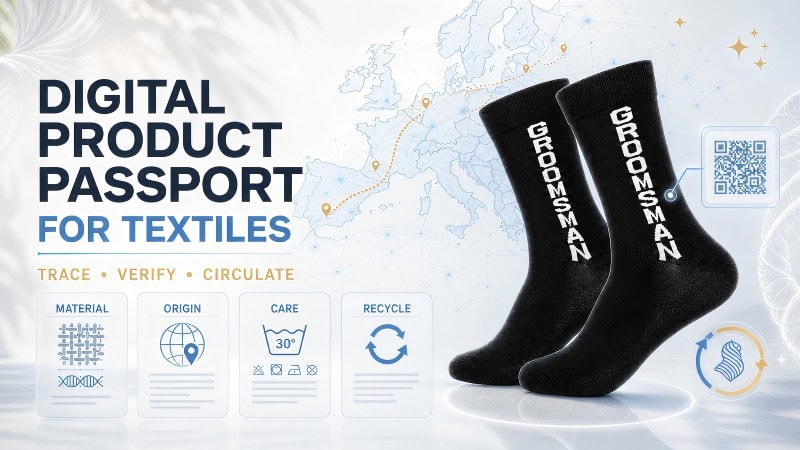
A digital product passport is a structured digital record for a product. Under the EU Ecodesign for Sustainable Products Regulation (ESPR), it will make selected sustainability, circularity, and compliance information accessible electronically.
The DPP is not simply a marketing webpage. It links a persistent unique product identifier to data that must be accurate, complete, current, and available to permitted users.
A data carrier—potentially a QR code or another machine-readable medium—must be physically present on the product, its packaging, or accompanying documentation, as specified by the future textile delegated act.
For fashion brands, the goal is practical transparency: consistent data that the fashion industry can use for better sourcing, verification, and circular decisions.
| What a DPP is | What a DPP is not |
| A digital record connected to a unique product identifier | A replacement for every physical product label |
| A system for controlled product information and traceability | A QR link containing unsupported sustainability claims |
| A tool for consumers, businesses, recyclers, and authorities | A certificate that automatically proves full compliance |
The ESPR requires open, interoperable data formats without vendor lock-in. Access rights may differ, so consumers, customs authorities, and supply chain partners may not see identical information.
EU DPP Timeline: What 2027 Really Means
The ESPR entered into force on July 18, 2024. It creates the framework, but final DPP requirements must be developed for individual product groups through delegated acts.
| Stage | Status | Buyer action |
| ESPR framework | In force | Understand roles, identifiers, data carriers, and data governance. |
| Textile preparatory study | Under development | Follow official proposals without treating draft data points as final law. |
| Textile delegated act | Indicative adoption in 2027 | Monitor the final scope, data requirements, verification, and application date. |
| DPP compliance date | Not yet fixed for textiles | Build reusable data collection before the final deadline is announced. |
The EU 2025–2030 working plan gives 2027 as the indicative adoption year for textile and apparel measures. It does not make 2027 a confirmed application deadline.
The EU battery passport offers an earlier sector example, but battery rules should not be copied into a textile DPP. Each product group receives its own performance requirements, information requirements, and implementation timetable.
DPP Data Requirements Textile Buyers Should Prepare
The final requirements for the digital product passport are still being developed. However, the ESPR framework and official textile studies show which data families deserve attention.
| Data family | Possible data points | Evidence to retain |
| Product identity | Style, SKU, model, batch, size, color, product category, country of origin | Approved specification, purchase order, and identifier register |
| Material composition | Fiber percentages, trims, coatings, recycled content, and raw material source | Bill of materials, source declarations, invoices, and certificates |
| Production process | Spinning, dyeing, knitting, finishing, assembly, facility, and production location | Factory records, batch files, process declarations, and change history |
| Performance and safety | Durability, substances of concern, care, and applicable test results | Laboratory reports, inspection records, and conformity documentation |
| Circularity | Recyclability, repair, reuse, disassembly, recycling, and end-of-life guidance | Design assessment, disposal instructions, and verified claim support |
| Environmental metrics | Potential carbon or environmental footprint and lifecycle information | Methodology, primary data, assumptions, and life cycle assessment |
Do not publish estimates as measured facts. For every field, record the source, unit, date, product scope, verification status, responsible owner, and approved version.
Keep each digital record available and updateable across the product lifecycle, even when a collection closes or a supplier relationship changes.
DPP Compliance Across the Textile Supply Chain
DPP compliance is a shared data challenge, but legal responsibility cannot be passed to a supplier through a casual request. Map who creates, verifies, approves, publishes, updates, and archives each field.
- Brand or product owner: defines the unique product, approves claims, and controls product data management.
- Raw material supplier: provides fiber origin, composition, transaction, and certification evidence where applicable.
- Manufacturer: records agreed materials, facilities, production details, batches, quality checks, and changes.
- EU importer: verifies that regulated products entering the EU market meet applicable requirements.
- Technology provider: manages digital infrastructure, access controls, data exchange, availability, and backups.
- Recycler: uses relevant data to identify materials and choose safer recycling routes.
For textile companies, the weak point is often not the QR itself. It is inconsistent supplier naming, missing source documents, changing blends, and data scattered across spreadsheets, email, PLM, and product information management systems.
A Seven-Step DPP Implementation Plan
- Set product scope. Select one textile product family and define whether records are controlled by model, batch, or item while awaiting final rules.
- Create a data dictionary. Define every field, unit, format, owner, evidence type, and update trigger.
- Map the supply chain. Connect yarn, dyeing, knitting, finishing, packaging, logistics, and relevant facilities.
- Run a gap assessment. Mark data as verified, source-declared, estimated, unavailable, or not applicable.
- Update supplier requirements. Add data formats, submission timing, evidence retention, and change notification to sourcing documents.
- Pilot one DPP. Build a digital record, generate a test QR, scan it after washing, and test access on common devices.
- Control updates. Revalidate DPP data whenever material composition, facility, process, label, or product design changes.
Start with the information you can substantiate. A smaller accurate dataset is more useful than detailed product information assembled from unsupported assumptions.
When developing custom socks, place the requested data fields in the specification before sampling. This makes data collection part of product development instead of an after-production exercise.
FAQs about Digital Product Passport for Textiles
Is the DPP for textiles mandatory now?
No textile-specific DPP obligation applies solely because the ESPR framework is in force. The relevant delegated act must define covered products, final requirements, granularity, verification, and the application date.
Will every pair of socks need its own QR code?
Not necessarily. The delegated act will determine whether DPP data refers to a model, batch, or individual item. Do not commit to item-level serialization before the textile rules are final.
Is a QR code the same as a DPP?
No. The QR is only a possible data carrier. The DPP also needs a persistent unique product identifier, accurate product information, appropriate access rights, interoperable data, and long-term availability.
Who is responsible for accurate product information?
The economic operator placing the regulated textile product on the EU market must meet the applicable obligation. Suppliers provide relevant data, but brands and importers should define ownership and verify evidence.
Should fashion brands wait for final requirements?
No. Avoid locking into an unconfirmed data template, but start organizing product, supplier, facility, material, and evidence records. These foundations support traceability, transparency, and future DPP implementation.
Prepare DPP-Ready Custom Sock Projects with SinoKnit
We are a wholesale custom sock manufacturer in Zhuji, China. Since 2004, we have supported OEM and ODM projects with material selection, artwork, sampling, production, customized packing, inspection, and worldwide export.
Planning socks for the EU market? Our production process shows where materials, samples, production, QC, packaging, and shipment information are created. Contact us with your design, quantity, destination, and required DPP data fields to discuss your project.