
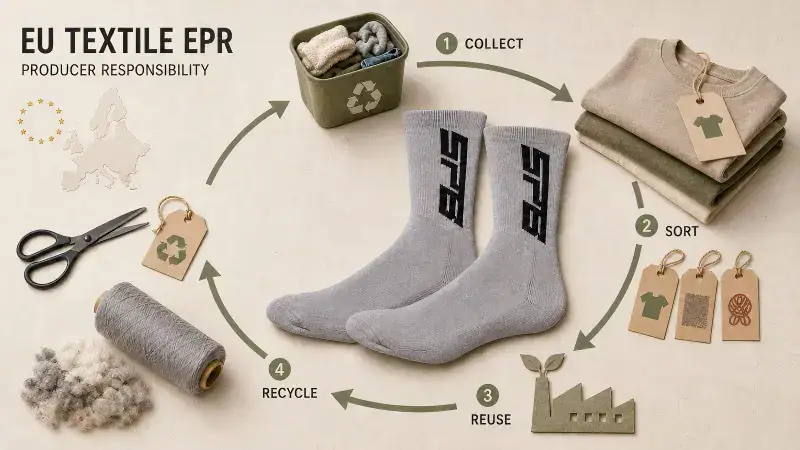
Selling socks, apparel, or shoes in Europe? EU textile EPR makes producers fund end-of-life collection and textile waste treatment. Use this guide to map your markets, responsibilities, data, fees, and next actions.
What EU Textile EPR Means for Producers
Extended producer responsibility shifts defined end-of-life costs from the public to companies that first make covered products available in a market. It supports collection, sorting, reuse, and recycling of textile waste.
The policy aims to reduce textile waste, recycle more fibers, and move the industry toward a circular economy.
Directive (EU) 2025/1892 amended the Waste Framework Directive and introduced mandatory extended producer responsibility for textile, textile-related, and footwear products.
- The EU framework is adopted. It entered into force on October 16, 2025.
- National implementation still matters. Each member state establishes and enforces its own scheme.
- The main deadline is April 17, 2028. EU member states must have the required EPR schemes in place by then.
- Microenterprises generally receive one extra year. The new provisions apply to qualifying microenterprises from April 17, 2029.
The amending EU directive sets the common direction. Existing national textile EPR laws can already create immediate compliance duties.
Textile EPR Scope and Producer Roles
The Annex IVc list covers more than fashion garments. Review the product codes instead of deciding scope from product descriptions alone.
| Product group | Common examples | Buyer check |
| Clothing and accessories | Socks, sportswear, workwear, underwear, hats | Confirm the CN code, product weight, and market quantity. |
| Footwear | Textile, leather, rubber, and plastic shoe categories | Do not assume a clothing-only national scheme already covers shoes. |
| Home textiles | Bed, table, toilet, and kitchen linen; blankets; curtains | Check the exact national textile scope and exclusions. |
| Used textile products | Specified worn clothing and other used textiles | Distinguish products assessed for reuse from collected textiles classified as waste. |
The producer is generally the business that first makes covered products available in a member state. Depending on the sales model, that could be a brand owner, manufacturer, importer, distributor, or distance seller.
Map the producer separately for every country and channel. Your overseas factory can provide product information, but it is not automatically the company responsible for national EPR compliance.
EU Textile EPR Timeline and National Schemes
The EU Waste Framework Directive creates a common EPR framework, not one central registration for all EU countries. Each member state still defines its registration and reporting process.
| Date | Requirement | What you should do |
| January 1, 2025 | Separate collection of textiles required across member states under earlier waste rules | Do not confuse municipal textile collection with producer registration. |
| October 16, 2025 | Directive (EU) 2025/1892 entered into force | Track each country’s transposition and consultation process. |
| April 17, 2028 | Required national textile and footwear EPR schemes established | Complete registration, reporting, fee, and representative arrangements on time. |
| April 17, 2029 | New provisions generally apply to qualifying microenterprises | Check whether an existing national scheme already includes small companies. |
France has operated a textile, household linen, and shoe system for years. The Netherlands introduced its national EPR for clothing and household textiles on July 1, 2023.
The Dutch government guidance already requires affected businesses to arrange free collection, meet reuse and recycle targets, and report annually. Foreign direct sellers must appoint a local authorised representative.
Older articles may describe new legislation as “expected in 2026.” That wording is outdated: the directive is adopted, while national rules continue to develop.
EPR Obligations, Fees, and Collection Systems
Exact obligations vary by member state, but most EPR systems use a similar operational model.
- Register the producer. Obtain the required national account or producer number.
- Join a producer responsibility organization. A PRO may operate collection systems and report on behalf of members.
- Declare products placed on the market. Reports may use weight, units, product category, or a combination.
- Pay EPR fees. The contribution funds textile collection, sorting, operations that reuse and recycle products, information campaigns, and related administration.
- Keep evidence. Retain calculations, declarations, invoices, registrations, product classifications, and correction records.
An EPR fee may be modulated using product sustainability criteria. Under the directive, future harmonised criteria can connect fees to relevant ecodesign requirements, circularity, durability, and recycling performance.
A lower-impact claim does not automatically reduce your fee. Use only the criteria, evidence, and application process accepted by the national scheme or producer responsibility organization.
A Seven-Step Textile EPR Compliance Plan
Textile producers should build the national reporting workflow before their first obligated sale, not at the annual declaration deadline.
- List every market. Record each EU country where you place textiles on the market, including direct online sales.
- Identify the producer. Document the brand owner, importer, seller of record, and authorised representative where applicable.
- Classify every SKU. Store CN code, product category, composition, net weight, units, and first-sale date.
- Connect product and sales data. Calculate textiles sold by country, reporting period, and channel.
- Register or join a PRO. Check local deadlines, declarations, contracts, and fee schedules.
- Budget the EPR fee. Separate fees from manufacturing and packaging EPR costs in your landed-cost model.
- Control changes. Review new countries, products, materials, weights, sellers, and legislation before launch.
When ordering custom socks, request confirmed fiber composition, pair weight, packaging method, SKU details, and production records. Your supplier data supports reporting, while your sales system supplies country volumes.
Common EPR Compliance Risks
| Risk | Why it happens | Better control |
| Wrong producer | Contracts do not match the actual import or sales flow. | Create a country-by-country responsibility matrix. |
| Missing textile weight | ERP records contain units but no verified net product weight. | Lock the approved weight by SKU and size range. |
| Late national registration | Teams wait for the 2028 EU deadline despite active national EPR laws. | Check current rules before the first sale in every country. |
| Mixed reporting boundaries | Returns, exports, samples, and marketplace sales are treated inconsistently. | Document calculation rules and retain a clear audit trail. |
These controls reduce compliance risks, but they do not replace local legal advice. National EPR regulations, textile legislation, scheme contracts, reporting portals, and fees can change.
FAQs about EU Textile EPR Compliance
Does textile EPR apply to socks?
Yes, socks normally fall within covered clothing categories. Confirm the CN classification and the national textile EPR scheme in every market where the socks are first made available.
Do producers need one EU registration?
No. The directive harmonises core requirements, but registration and reporting remain national. You may need a separate account, PRO arrangement, representative, declaration, and payment in each relevant member state.
Must non-EU fashion brands comply?
They can be in scope when selling directly or placing textile products on an EU market. Check the producer definition, importer arrangement, marketplace flow, and authorised-representative rules country by country.
What data should a sock buyer request?
Request SKU identity, fiber composition, pair weight, size range, units, packaging configuration, and change records. Combine this production data with your own country-level sales and returns data.
Is EPR the same as textile recycling?
No. Textile recycling is one funded activity that helps operators recycle fibers. The EPR system can also cover collection, transport, sorting, reuse, public information, reporting, research, and treatment of unrecyclable textile waste.
Prepare Your Custom Sock Data with SinoKnit
We are a wholesale custom sock manufacturer in Zhuji, China. Since 2004, we have supported OEM and ODM projects with material selection, artwork, sampling, production, customized packing, inspection, and worldwide export.
Preparing for textile EPR? Our production process covers the stages where product specifications, materials, samples, packaging, QC, and shipment information are created. Contact us with your design, quantities, destination markets, and required data fields.