
Like any piece of outdoor equipment, a trampoline ages with time—parts wear out and eventually need to be replaced. Before you order any new pieces, getting the measurements right is key. But are you sure you’re measuring everything you need to?
Measuring a trampoline is a task where the “measure twice, cut once” philosophy holds true. This guide breaks down exactly how to measure every part of your trampoline, no matter what kind you own. Keep reading to get it done right.
Knowing the Components of a Trampoline
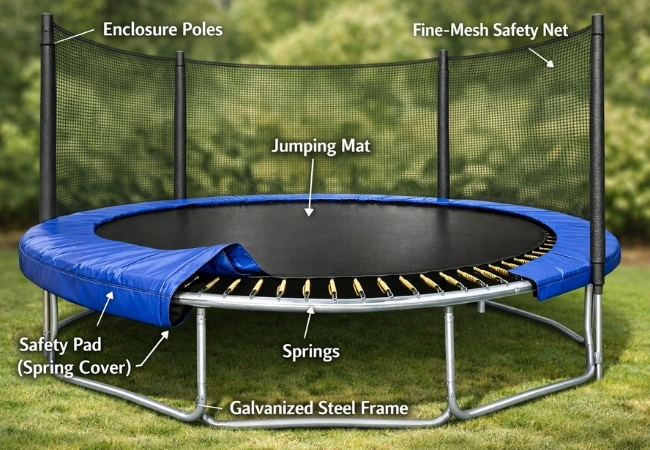
Before measuring your trampoline, it helps to know the key parts you’re working with. Most backyard trampolines have:
- Frame – The rigid metal structure that defines the shape and size (round, rectangular, octagonal, or oval). All official trampoline sizes are based on the outer frame, not the mat.
- Jumping Mat – The black (or sometimes colored) fabric surface you bounce on. It attaches to the frame using springs.
- Springs – Metal coils that connect the mat to the frame. They vary in length and number from model to model.
- Spring Holes – Openings or hooks along the frame where springs attach. The number and spacing of these determine what mat will fit.
- Safety Pad (Spring Cover) – The padded ring or segments that cover the springs and frame edges to prevent injuries.
- Enclosure Poles and Net – Vertical poles attached to the frame that hold up a safety net surrounding the jump area.
When you’re measuring, you are almost always measuring frame, springs, and poles—not the mat or padding, which can stretch, shrink, or warp over time.
Why Accurate Trampoline Measurements Matter
Trampoline parts are not one-size-fits-all. Two trampolines may both be advertised as 12 ft models, but they can have different spring lengths, different numbers of spring holes, or slightly different frame designs. If your measurements are off by even a small amount, you may end up with:
- A mat that is too tight, overstretching springs and increasing the risk of tearing.
- A mat that is too loose, causing poor bounce and unsafe landings.
- Pads or nets that don’t sit correctly, leaving gaps where feet or hands can slip through.
Accurate measurements directly affect:
- Safety – Poorly fitting parts can create pinch points, exposed metal, and uneven tension.
- Performance – The “feel” of the bounce depends on the correct combination of frame size, spring count, and spring length.
- Cost and convenience – Returns for bulky trampoline parts are expensive and time-consuming.
Spending a few extra minutes measuring carefully will save you money, frustration, and greatly reduce safety risks.
An Important Measuring Tip – Avoid the “Mat-Only” Trap
It is incredibly common for users to measure the black jumping surface and assume that is the size. However, the listed size actually refers to the metal frame dimensions. The jumping mat will naturally be smaller to allow room for the springs. Therefore, always measure from the outer metal edge of the trampoline frame.
How to Measure Round Trampolines
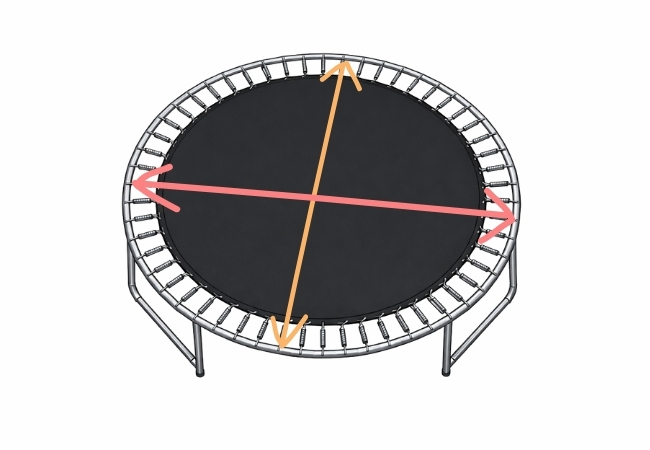
Round trampolines are the most popular backyard models, but they are also the most prone to “frame warping.” Because the tension of the springs pulls inward from all directions, an older frame might actually become slightly oval over time. To get an accurate reading, you must account for this.
- The Cross-Measurement: Stand on one side of the trampoline and hook your tape measure to the outer edge of the steel frame. Pull the tape across the center of the mat to the opposite outer edge. Note the measurement.
- The Second Check: Move 90 degrees around the trampoline and repeat the process. This creates an “X” or cross-shape with your measurement lines.
- Averaging: If your first measurement was 14 feet and your second was 13 feet 10 inches, your frame has likely warped. In this case, you should look for parts that accommodate the average or contact a specialist to see which size is most compatible with that specific model’s spring count.
How to Measure Rectangular Trampolines
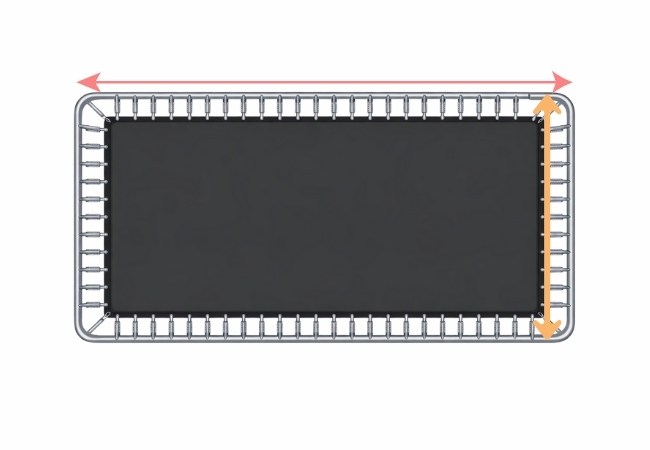
Rectangular or square trampolines are often used by gymnasts or those with narrow backyards. Unlike round models, these frames do not have a single diameter; they are defined by their length and width.
- Width First: Measure from the outer metal edge of one short side to the outer metal edge of the opposite short side.
- Length Second: Measure from the outer metal edge of one long side to the outer metal edge of the opposite long side.
How to Measure Octagonal Trampolines
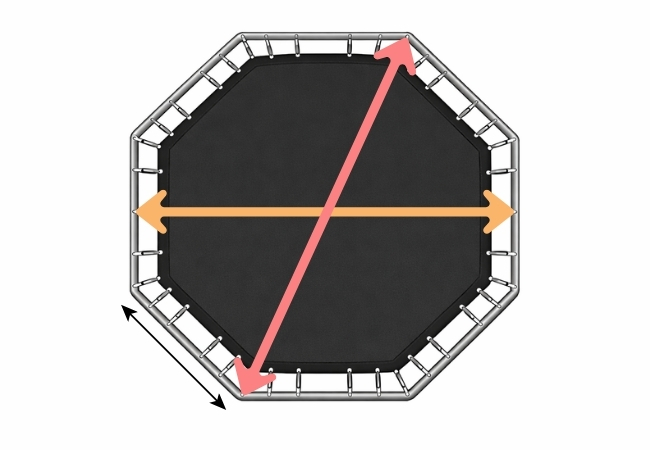
Octagonal trampolines offer a unique aesthetic and a specialized bounce, but they can be tricky to measure because they feature eight corners and eight flat sides. To get an accurate size, you must measure across the widest points.
- Point-to-Point Measurement: First, locate the center point by identifying where two metal frame poles intersect. From that center, measure the straight-line distance from the outermost point of one corner directly to the opposite corner. This represents the longest diagonal measurement of the octagonal trampoline.
- Flat-to-Flat Check: For additional confirmation, measure from the center of one flat rail to the center of the opposite flat rail. This distance will be slightly shorter than the point-to-point measurement, but it helps verify the frame’s symmetry.
- Rail Length: Measure the length of a single flat metal rail. Knowing the length of one of the eight sides is extremely helpful when ordering replacement safety pads, as it ensures each section of the pad is the correct length to cover the frame segments.
How to Measure Oval Trampolines
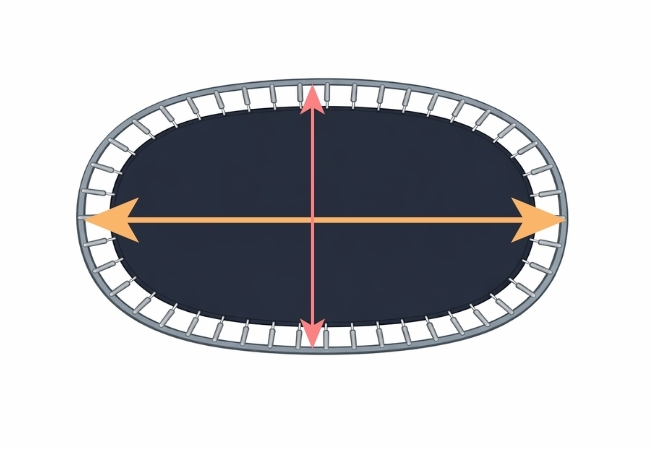
Oval trampolines can be the most confusing to measure because they combine the curves of a round model with the dual-axis dimensions of a rectangle.
- The Long Axis: Measure the longest part of the oval from the outer metal edge to the opposite outer metal edge.
- The Short Axis: Measure the narrowest part of the oval (the width) from the outer metal edge to the opposite outer metal edge.
- Confirming Alignment: To ensure you are getting the true center, it is helpful to have a second person hold the tape measure at the peak of the curve while you pull it across to the corresponding peak on the other side.
Additional Critical Measurements
Once you have the frame size, you aren’t quite finished. If you are ordering a new jumping mat or safety net, you will need two more specific pieces of data:
- Spring Length: This is where many people fail. To measure a spring, you must remove it from the trampoline. A spring under tension is stretched and will give you a false reading. Take a completely loose spring and measure it from the very tip of one hook to the very tip of the other. Common lengths are 5.5, 7, or 8.5 inches.
- Spring Count: This is the most vital step for a replacement mat. Physically count every single spring on your trampoline. Alternatively, count the holes in the frame. Even two 12-foot trampolines can have different spring counts (e.g., one might have 72 springs while another has 80).
- Enclosure Pole Diameter and Height: If replacing a net, measure the height of the poles from the frame up and use a caliper or tape to find the diameter of the pole (usually 1 inch or 1.5 inches).
Important Considerations
Before you click “buy” on those replacement parts, keep these final tips in mind. First, check your units of measurement. While most trampolines in the US and Australia are sold in feet, many European models use centimeters. Converting between the two can lead to rounding errors, so try to use the unit the manufacturer originally provided.
Second, consider the condition of your frame. If the steel is significantly rusted or the joints are “bowing” inward, the frame may no longer be structurally sound. In such cases, no amount of new padding or mats will make the trampoline safe, and it may be time for a full replacement.
Finally, always look for a model name or number on the frame’s legs or the underside of the safety padding. This can often lead you to a manufacturer’s spec sheet, which overrides any manual measurements you might take.
FAQs
Can I use a mat from a different brand if the size is the same?
Yes, provided the frame diameter, spring count, AND spring length all match perfectly. If any of those three variables are off, the mat will not fit.
My trampoline is 11 feet 9 inches. Should I buy a 12-foot mat?
Most “12-foot” trampolines are actually exactly 12 feet. If yours is slightly less, it might be warped. However, some brands use unique sizing. Always round to the nearest “standard” size only after confirming with the spring count and spring length.
Do I measure the safety padding?
No. Safety padding can stretch or shrink over time due to the weather. Only the metal frame provides a reliable, static measurement.
What to wear for trampolining?
Trampoline socks with rubber grips are highly recommended for safety and hygiene. They help prevent slipping and protect your feet from friction burns. Importantly, aside from personal hygiene, these socks also keep the trampoline clean and help extend its lifespan by reducing mat wear.