If you ask me whether you should go barefoot or wear socks on a trampoline, the most honest answer is: it depends. The best choice often comes down to your setting, your comfort level, your safety considerations, and even your personal preference.
There is no one perfect rule for everyone. What matters most is understanding the advantages and risks of each option, then choosing what fits your situation best.
In this article, you’ll learn:
- The pros and cons of going barefoot vs wearing trampoline socks
- Why regular socks are the most dangerous option
- A 30-second decision guide to help you choose
- How to pick a good pair of trampoline socks (and what materials to look for)
- Common myths about trampoline socks — busted
- Special situations: kids, injuries, wet mats, and more
Let’s start with the most common question trampoline users have.
Going Barefoot or Wearing Socks on a Trampoline?
This is probably the most common question trampoline users have. Your feet are your main point of contact with the mat, and how you protect — or expose — them affects your traction, balance, landing, and overall jumping experience. Here is a closer look at each option.
Going Barefoot
✅ Benefits
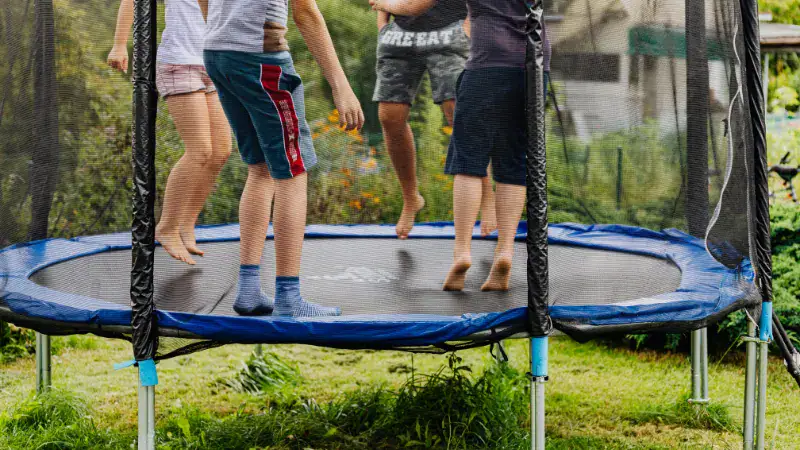
Bare feet allow direct contact with the trampoline mat, giving you a natural feel for the surface. That connection helps with balance and control, since your toes and the soles of your feet can grip and respond to movement in a way that even the best socks cannot fully replicate.
Without any extra layer, you also get a fuller range of motion through your toes and ankles — making jumping feel more intuitive and fluid. For people who trampoline regularly, this natural feedback from the mat is often exactly what they prefer.
⚠️ Risks
In shared spaces like many trampoline parks, hygiene becomes a genuine concern. Walking barefoot on a public mat that dozens of people use each day can expose your feet to bacteria and general dirt — something worth thinking about seriously on any park visit.
Longer jumping sessions can also bring minor abrasion or soreness from repeated friction. In colder weather, bare feet can simply feel less comfortable, especially inside a gym or an outdoor setting.
Wearing Trampoline Socks
✅ Benefits
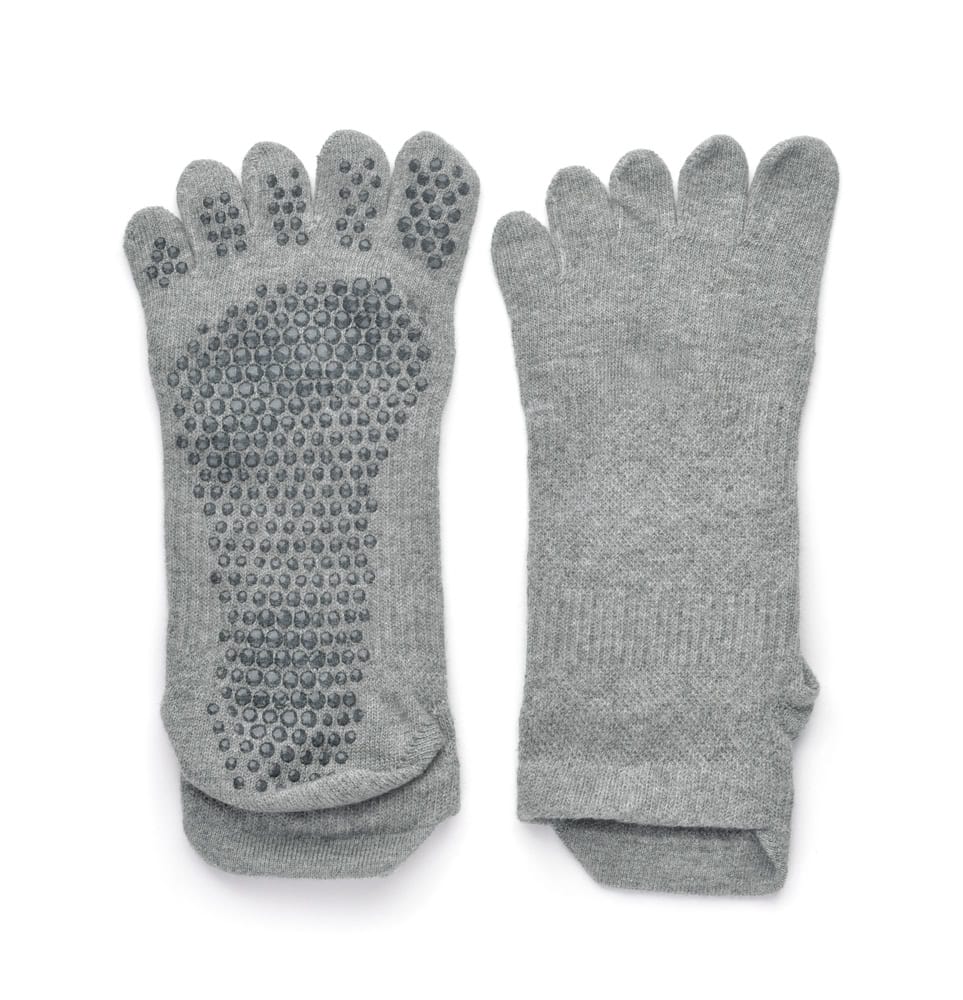
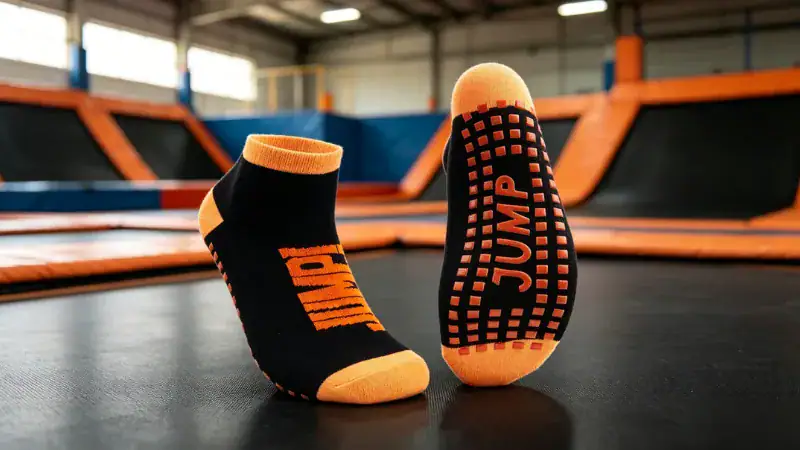
Specialized trampoline socks — often called grip socks, jump socks, or anti-slip socks — are built for this activity. The biggest win is traction: quality pairs feature non-slip soles or rubberized soles that grip the mat and reduce the chance of slipping on landing. For beginners and kids, this confidence boost is real.
Hygiene is another clear advantage — wearing socks creates a protective barrier between your feet and a shared mat, which is especially valuable when visiting a trampoline park. Many parks require socks for exactly this reason.
Comfort-wise, many options are made with breathable fabrics and moisture-wicking materials that keep your feet dry. Some offer a snug fit with light compression and mild cushion underfoot. Parents especially appreciate one option that covers health and safety, hygiene, and comfort all at once — for children and adults alike.
⚠️ Risks
Even specialized socks have trade-offs. Some people find that any layer on the foot reduces their sense of direct contact with the mat — a real consideration if balance and control are your top priority.
Fit and quality also matter. A pair with poor elasticity or a worn-out sole may move around during jumping and become a distraction rather than a help. Always check that your socks are genuinely designed for trampolining — not just branded that way.
🚫 Risks of Wearing Regular Socks
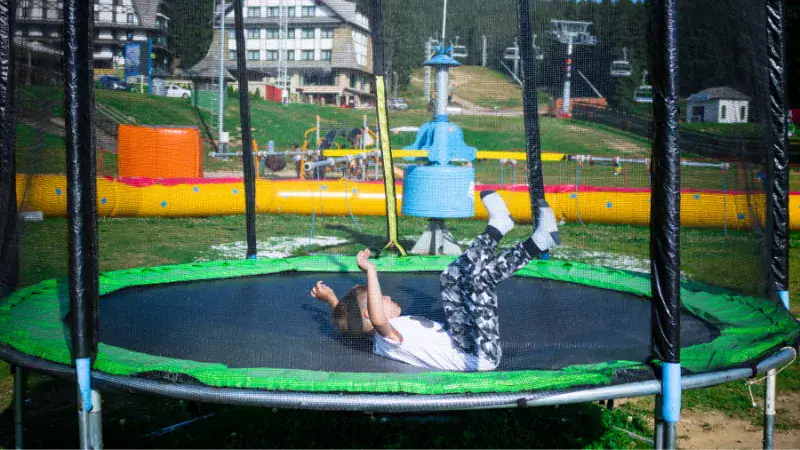
If there is one option most safety guidelines agree on, it’s this: regular socks are the least suitable choice for jumping on a trampoline. Standard socks are made for walking, not bouncing. They typically have smooth soles that become dangerously slippery on a mat — especially during fast movement or awkward landings.
Without non-slip soles or real traction features, they combine the downsides of going barefoot with the downsides of wearing socks. They can bunch up, shift around, and give a false sense of security. When it comes to injury prevention, this is the option worth avoiding most.
Trampoline Socks or Bare Feet? How to Choose
30-Second Decision Guide
Ask yourself three yes/no questions:
📍1. Are you jumping at a public trampoline park?
- Yes → Wear trampoline socks
- No → Go to question 2
🧦2. Is it cold, or do you mind getting your feet dirty?
- Yes → Wear trampoline socks
- No → Go to question 3
🎯3. Do you want maximum feel and control, and is the mat clean?
- Yes → Go barefoot
- No → Wear trampoline socks (safest choice)
Bottom line: Trampoline socks work for 90% of situations. Barefoot is only best under specific conditions.
Here is a simple comparison table:
| Option | Traction | Hygiene | Comfort | Verdict |
|---|---|---|---|---|
| Bare Feet | ⭐⭐⭐⭐⭐ | ⭐⭐ | ⭐⭐⭐⭐ | Best for home |
| Grip / Trampoline Socks | ⭐⭐⭐⭐ | ⭐⭐⭐⭐⭐ | ⭐⭐⭐⭐⭐ | Best for parks |
| Regular Socks | ⭐ | ⭐⭐⭐ | ⭐⭐⭐ | Avoid |
Whatever you choose, keep safety considerations in mind, follow the safety guidelines of your space, and make sure your footwear — or lack of it — supports a fun, confident, and safe jumping experience.
How to Choose a Good Pair of Trampoline Socks
What to Look For in Trampoline Socks
| Feature | What’s Good | What to Avoid |
|---|---|---|
| Grip dots | Dense silicone/rubber dots, raised texture, covers entire sole | Only a few dots, flat or worn down |
| Material | Blends with spandex (e.g., polyester + spandex or cotton-polyester + spandex), labeled “moisture-wicking” | 100% synthetic (sweaty), 100% cotton (doesn’t stay in place) |
| Fit | Snug around the ankle, reinforced heel, stays put | Loose, loses shape after two washes |
| Thickness | Medium (too thin = no grip, too thick = less feel) | Towel-sock thick |
3 Common Myths About Trampoline Socks
Myth 1: “Wearing two pairs of socks gives more grip.”
Truth: False. The two layers slide against each other, making things worse.
Myth 2: “Any non-slip sock works fine.”
Truth: False. Yoga socks and floor socks are designed for static activities. Trampoline socks need a dynamic grip for bouncing.
Myth 3: “Socks make jumping less tiring.”
Truth: Not really. They add minor cushioning but won’t reduce fatigue. Proper jumping form matters far more.
Special Situations
| Situation | Recommendation |
|---|---|
| Open sore / blister on foot | Wear trampoline socks (for protection) — or don’t jump until it heals |
| Wet trampoline mat (just washed or damp) | Nothing works. Wait until fully dry. All footwear slips on wet surfaces. |
| Can I wear shoes? | Regular shoes damage the mat. Clean indoor court shoes are occasionally okay, but not recommended. |
| Pregnant or elderly | Prioritize trampoline socks (for confidence + warmth), but check with a doctor first. |
| Learning flips or advanced tricks | Go barefoot (this is what professionals choose) — but only with proper coaching and spotting. |
What Should Kids Wear? (For Parents)
| Age Group | Recommendation |
|---|---|
| Ages 3–6 | Trampoline socks first. Young feet are sensitive. Also, most kids’ trampoline parks require them. |
| Ages 7–12 | Depends on setting: barefoot is fine at home in summer; trampoline socks are better at parks or in cold weather. |
| Safety note | Do not let kids jump in regular socks. There are documented cases of chin injuries from slipping. |
| Fun tip | Buy trampoline socks with cartoon characters or bright colors. Kids are much more willing to wear them. |